
Daily control
Labour hours, sales per labour hour, table turns, covers and waste tracking.
Most restaurant managers know when something feels wrong, but not always why. The right KPIs show where labour is slipping, where food cost is creeping and where margin is being lost before it appears in the accounts.
Running a successful restaurant is not just about sales. Strong hospitality operations depend on understanding the numbers behind performance, staffing, profitability and guest behaviour.
Without reliable restaurant KPIs, most operational decisions are based on gut feel, and gut feel is expensive when margins are already thin. KPIs give managers visibility before problems become obvious.
The goal of restaurant KPIs is not simply reporting numbers. The goal is improving decisions before operational issues damage profitability or guest experience.
Every hospitality business tracks different metrics depending on concept, service style and business model. However, some KPIs are essential for almost every restaurant, café, bar or hospitality operation.
| KPI | Why it matters |
|---|---|
| Labour Cost Percentage | Shows how much revenue is spent on staffing costs. |
| Food Cost Percentage | Measures ingredient cost against sales revenue. |
| Prime Cost | Combines labour and food cost to measure operational efficiency. |
| Sales Per Labour Hour | Measures team productivity and staffing efficiency. |
| Average Spend Per Guest | Shows how much customers spend per visit. |
| Table Turn Time | Measures how efficiently tables are being used. |
Labour cost percentage is one of the most important hospitality KPIs because staffing is usually one of the largest controllable expenses in a restaurant.
High labour percentages may indicate overstaffing, weak scheduling or inefficient operations. Low labour percentages may indicate understaffing, poor service quality or pressure on the team.
If you want to learn more about labour benchmarks, read the restaurant labour cost percentage guide or the full Restaurant Labour Cost Guide.
Food cost percentage measures how much of food revenue is being consumed by ingredients and product costs. It is one of the clearest ways to understand whether recipes, menu pricing and kitchen controls are sustainable.
Rising supplier prices, waste, poor portion control and menu imbalance can quickly damage profitability if food cost is not tracked consistently.
For deeper food cost guidance, read the Restaurant Food Cost Guide.
Prime cost combines labour cost and food cost together. Many operators consider prime cost one of the most important restaurant KPIs because it measures total controllable cost pressure.
Prime Cost = Total Labour Cost + Total Food Cost
Restaurants with healthy prime cost percentages generally have stronger operational control and better long-term profitability. For a full explanation, read the Restaurant Prime Cost Guide.
Sales per labour hour measures how efficiently staffing levels generate revenue. This KPI is extremely useful when building rotas or reviewing shift productivity because it helps identify overstaffed periods and weak labour planning.
Sales Per Labour Hour = Total Sales ÷ Total Labour Hours
If one shift consistently generates low sales per labour hour, staffing structure, service timing or demand forecasting may need adjustment.
For a dedicated explanation of this metric, read Sales Per Labour Hour: Formula and Restaurant Examples.
Average spend per guest helps operators understand customer spending behaviour and sales opportunities. Improving average spend often increases profitability faster than reducing costs alone.
Table turn time measures how long tables are occupied before new guests are seated. Faster table turns can improve revenue capacity, but pushing speed too aggressively can damage guest experience.
Strong hospitality operators balance efficiency with service quality rather than chasing speed alone. A good table turn KPI should help remove unnecessary delays without making guests feel rushed.
Restaurant KPIs work best when managers separate operational indicators from financial outcomes. Financial KPIs show the result. Operational KPIs help explain why that result happened.
Margin KPIs can also answer different questions. For example, cash margin vs profit margin helps managers separate usable trading cash from final profitability, which makes weekly KPI reviews more practical.
When reviewing net profit margin as a KPI, managers should also know what a good restaurant profit margin looks like for their restaurant type, service model and cost structure.
Labour hours, sales per labour hour, table turns, covers and waste tracking.
Food cost percentage, labour percentage, prime cost and contribution margin.
Average spend, sales mix, repeat visits and category performance.
Different KPIs should be reviewed at different frequencies. Daily checks help managers react during the week, while weekly reviews help identify trends and make better planning decisions.
| KPI | Recommended frequency |
|---|---|
| Labour Cost | Daily / weekly |
| Sales Performance | Daily |
| Food Cost | Weekly |
| Prime Cost | Weekly |
| Average Spend | Weekly or monthly |
A KPI routine does not need to be complex. The best system is one managers actually use. Start with five core numbers and review them every week at the same time.
The restaurants that consistently perform well are not necessarily the busiest or the most popular. They are the ones where managers know their numbers every week and act on them before problems become expensive to fix.
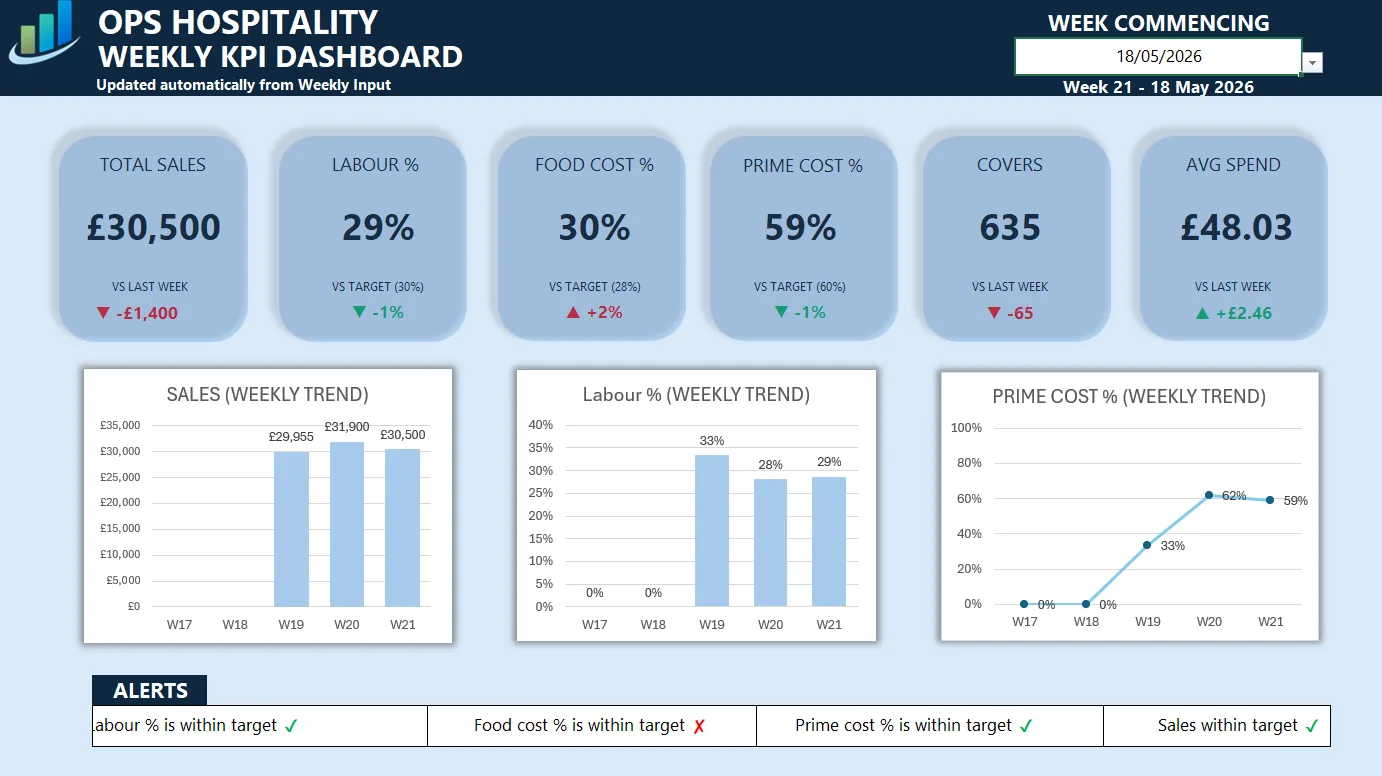
Knowing which KPIs matter is the first step. The next step is tracking them consistently. Use the Weekly KPI Dashboard to monitor sales, labour cost, food cost, prime cost, cash margin, targets and weekly performance trends in one Excel workbook.
View KPI DashboardUse the free KPI Calculator for quick checks, or use the Weekly KPI Dashboard when you want a structured Excel system for weekly targets, trends and management review.
Restaurant KPIs are performance indicators used to measure profitability, staffing efficiency, food cost, sales performance and operational health.
Many operators consider prime cost one of the most important KPIs because it combines labour cost and food cost together.
Labour and sales KPIs are often reviewed daily, while broader profitability metrics such as prime cost and food cost are commonly reviewed weekly.
KPIs help hospitality managers improve operational decisions, control costs, increase profitability and maintain service standards.