
What Is a Good Restaurant Profit Margin?
Learn what a good restaurant profit margin looks like, which benchmark ranges are realistic, and how hospitality operators can judge whether their margin is healthy or hiding deeper cost problems.
Good restaurant profit margin: quick answer
A good restaurant profit margin is often around 5% to 10% net profit margin, but the right benchmark depends on the restaurant type, service model, location, rent, labour structure, menu pricing and cost control.
In many restaurants, profit margin is thin because food cost, labour cost, rent, utilities, delivery fees, waste and other overheads all reduce the amount of sales the business keeps. That is why a good restaurant profit margin should be judged by concept, consistency and cash flow, not by one percentage alone.
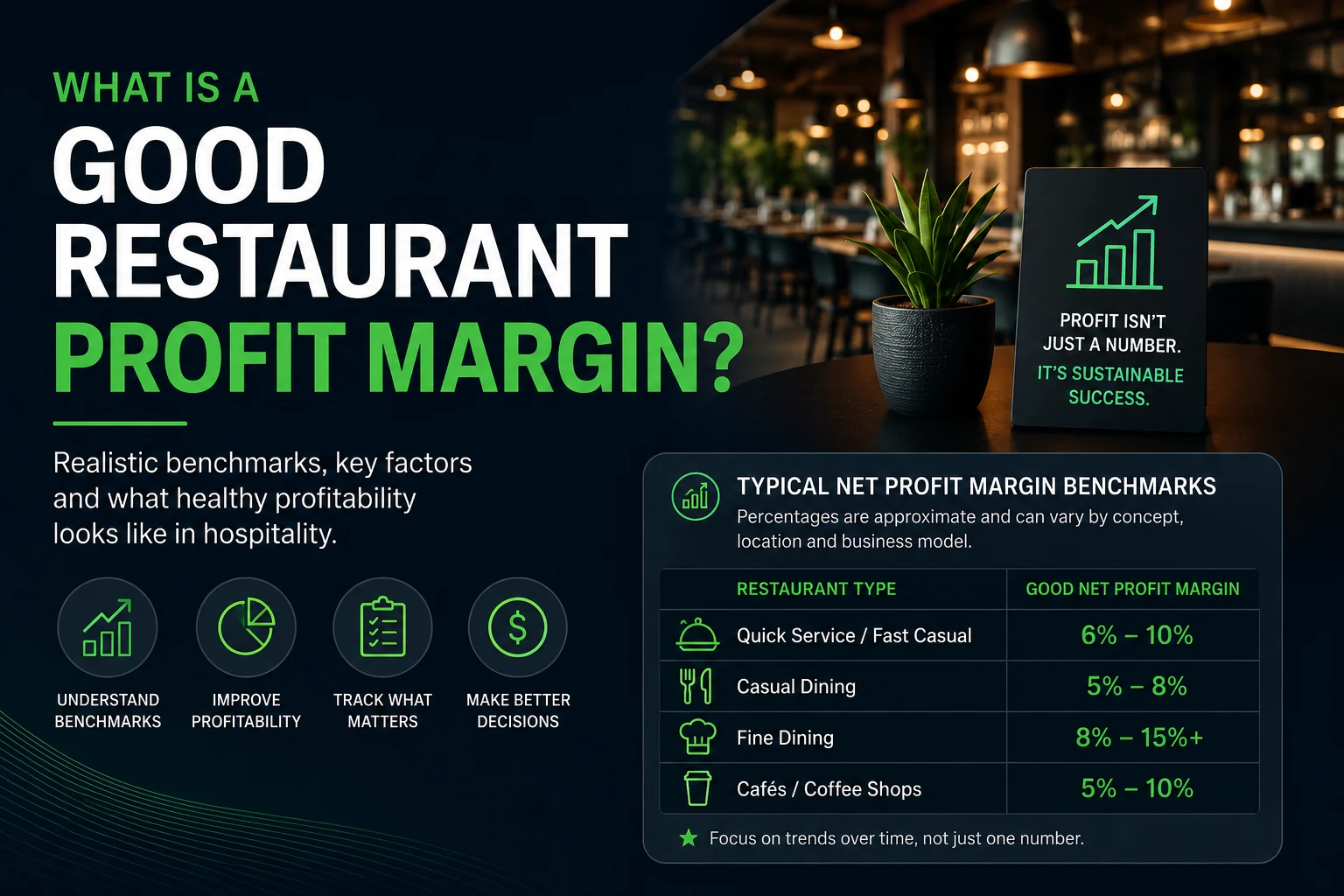
Good restaurant profit margin benchmarks
There is no single good restaurant profit margin benchmark that fits every restaurant. A casual dining restaurant, café, bar, hotel outlet, fine dining venue and quick-service operation can all have different cost structures.
The ranges below are practical reference points. They should not replace your own financial targets, but they can help you understand whether your current restaurant profit margin looks weak, normal or strong for your type of operation.
| Restaurant type | Possible good net profit margin | Why it varies |
|---|---|---|
| Full-service restaurant | 3% – 6% | Higher labour needs, table service, broader menus and more complex operations can reduce final margin. |
| Quick-service or fast casual | 6% – 10% | Simpler menus, faster service, higher volume and tighter systems can support stronger margins. |
| Café or coffee shop | 5% – 10% | Margins depend on rent, labour scheduling, product mix, wastage and morning trade volume. |
| Fine dining | 5% – 12%+ | Higher spend per head can help, but skilled labour, premium ingredients and service standards also raise costs. |
| Delivery-heavy restaurant | Often lower unless tightly controlled | Delivery commissions, packaging, discounts and third-party dependency can reduce the profit kept from sales. |
Operator insight: use benchmarks as a guide, not as a final judgement. A 5% margin with strong cash flow and improving trends may be healthier than a one-off 10% margin created by short-term cost cuts.
How to calculate a good restaurant profit margin
To know whether your restaurant margin is good, first make sure you are calculating the same margin type. Net profit margin is usually the most useful benchmark for overall business health because it looks at final profit after costs.
For example, if a restaurant generates 100,000 in sales and keeps 7,000 as net profit, the net profit margin is 7%. Whether that is a good restaurant profit margin depends on the concept, risk level, debt, rent, seasonality and how consistent the result is over time.
If you want the full calculation breakdown, read the Restaurant Profit Margin Formula guide.
Restaurant profit margin example
Imagine a casual restaurant has the following monthly figures:
| Item | Amount | How it affects margin |
|---|---|---|
| Sales | 120,000 | Starting point for the calculation. |
| Food and beverage cost | 36,000 | Reduces gross profit. |
| Labour cost | 38,000 | Usually one of the biggest controllable costs. |
| Rent, utilities, admin and other overheads | 34,800 | Reduces final profit after operating costs. |
| Net profit | 11,200 | Used to calculate net profit margin. |
Net profit margin calculation
In this example, a 9.3% net profit margin would usually be considered a good restaurant profit margin for many restaurant models, especially if it is consistent and not created by under-staffing, poor quality control or delayed maintenance.
What makes a restaurant profit margin healthy?
A good restaurant profit margin is not just about hitting a percentage. It should be repeatable, supported by cash flow and achieved without damaging the guest experience or the team.
It repeats over time
A healthy margin should appear across several periods, not only during one strong month or seasonal peak.
Prime cost is managed
Food cost and labour cost usually have the biggest impact on restaurant profitability.
Cash flow supports it
Profit on paper is not enough if the business cannot meet supplier, payroll, rent or tax commitments.
A restaurant with a healthy margin should also have enough room for reinvestment, repairs, training, marketing, owner returns and future cost increases.
Why restaurant profit margins are often low
Restaurant profit margins are often low because many costs move at the same time. Food prices, wages, rent, utilities, repairs, delivery fees, payment charges and waste can all reduce the amount of profit kept from sales.
- Supplier prices may rise faster than menu prices.
- Labour schedules may not match real demand by day or hour.
- Waste, over-portioning and poor stock control can reduce margin quietly.
- Delivery commissions and discounts can increase sales while reducing profit.
- High rent or fixed costs can make the break-even point harder to reach.
- Managers may review sales daily but check profit margin too late.
Simple check: if sales are growing but profit margin is falling, the restaurant is probably increasing revenue without protecting enough contribution from each sale.
Profit margin vs cash margin
Profit margin and cash margin are connected, but they are not the same. Profit margin shows whether the business is profitable over a period. Cash margin helps operators understand whether enough cash is being kept after the real movement of money.
This matters because a restaurant can look profitable in reports while still facing cash pressure from supplier payments, payroll, rent, tax, loan repayments, deposits, refunds or seasonal timing.
To compare both metrics, read Cash Margin vs Profit Margin in Restaurants. For a wider explanation, read Restaurant Cash Flow vs Profit.
How prime cost affects restaurant profit margin
Prime cost combines food cost and labour cost. These are usually the two biggest controllable cost areas in a restaurant, so prime cost has a direct impact on profit margin.
If food cost or labour cost increases faster than sales, net profit margin usually becomes weaker. This can happen when recipes are not updated, menus are priced incorrectly, labour is over-scheduled or supplier costs rise without action.
To go deeper, read the Restaurant Prime Cost Guide or the article What Is Prime Cost in a Restaurant?.
How to improve a good restaurant profit margin
Improving restaurant profit margin does not always mean cutting quality. In most restaurants, a good restaurant profit margin comes from stronger pricing, cleaner systems, better forecasting and more consistent cost control.
1. Review menu pricing and contribution margin
A popular item can still damage profit margin if ingredient cost, prep time, waste or delivery fees are too high. Review contribution margin, not only food cost percentage.
2. Plan labour before the week starts
Labour cost is easier to control before shifts are worked. Forecast sales, plan sections and review labour hours before payroll becomes fixed.
3. Re-cost recipes when supplier prices change
Restaurant margins can fall quietly when supplier prices increase but recipes and menu prices are not updated.
4. Reduce waste and over-portioning
Waste reduces profit twice: the business pays for the product, then loses the sales value it could have generated.
5. Watch delivery, discounts and commissions
Discounts and third-party delivery fees can make revenue look stronger while reducing the profit kept from each order.
6. Review KPIs weekly
Profit margin becomes more useful when reviewed alongside food cost, labour cost, prime cost, cash margin, break-even sales and average spend.
Use the Restaurant KPI Calculator to connect profit margin with other key hospitality numbers.
Common mistakes when judging a good restaurant profit margin
- Comparing a full-service restaurant with a quick-service business.
- Looking at one month instead of margin trends over time.
- Ignoring cash flow when profit margin looks good.
- Using gross profit margin when the real question is net profit margin.
- Assuming higher sales automatically mean better profitability.
- Ignoring delivery commissions, discounts, waste and hidden cost leaks.
- Cutting labour or quality so aggressively that guest experience suffers.
Better question: is the margin strong enough to cover risk, reinvestment, tax, debt, repairs, owner returns and future cost increases?
Good restaurant profit margin FAQs
What is considered a good restaurant profit margin?
A good restaurant profit margin is often around 5% to 10% net profit margin, but the right benchmark depends on the concept, service style, rent, labour model, location and cost control.
Is a 10% profit margin good for a restaurant?
Yes. A 10% net profit margin is usually strong for a restaurant if it is consistent and not created by short-term cuts that damage product quality, service or team stability.
Is a 5% profit margin good for a restaurant?
A 5% net profit margin can be good for a full-service restaurant if cash flow is controlled, costs are stable and the business is not relying on unsustainable discounts or under-staffing.
Why are restaurant profit margins so low?
Restaurant margins are often low because food, labour, rent, utilities, repairs, payment fees, waste and delivery commissions all reduce the amount of profit kept from sales.
What is more important: profit margin or cash flow?
Both matter. Profit margin shows whether the restaurant is profitable over a period, while cash flow shows whether money is available when real payments are due.
How can restaurants improve profit margin?
Restaurants can improve profit margin by reviewing menu pricing, controlling food cost, planning labour carefully, reducing waste, managing delivery costs and tracking KPIs weekly.
Check whether your restaurant profitability is healthy
A good restaurant profit margin becomes more useful when it is reviewed alongside sales, labour cost, food cost, prime cost, cash margin, cash flow and break-even sales. Use the free Ops Hospitality tools to connect the numbers behind restaurant profitability.