
Revenue without margin
High sales can hide weak pricing, poor contribution margin or expensive menu items.
Learn how restaurant profitability really works, why busy venues still lose money, which margins and KPIs matter most, and how operators protect profit through better labour, food cost, pricing and break-even control.
Restaurant profitability is the ability to generate consistent profit after covering food cost, labour cost, operating expenses, overheads and tax obligations. Strong sales alone do not guarantee profitability because revenue can disappear quickly when labour, ingredients, rent, waste and operating costs are not controlled.
Many busy restaurants struggle financially because operational systems are weak. Margin is usually lost through small inefficiencies repeated daily across labour scheduling, menu pricing, inventory management, purchasing, prep and service execution.
A busy restaurant is not the same as a profitable one. Profitability comes from controlling what happens between the sale and the final margin.
To turn these numbers into a quick diagnostic, use the Restaurant Profitability Score Calculator to check profitability, cost pressure and payment coverage in one restaurant health score.
A restaurant can be full and still unprofitable if the cost structure is weak. High sales volume helps, but it does not automatically protect margin. If labour is over-scheduled, food cost is too high, rent is heavy or menu pricing is outdated, the business can feel busy while cash becomes tighter.
High sales can hide weak pricing, poor contribution margin or expensive menu items.
More customers often require more staff, but poor rota planning can turn demand into payroll pressure.
Over-portioning, spoilage and supplier increases become more expensive at higher volume.
This is why profitable operators do not only ask, “How much did we sell?” They also ask, “How much did we keep?” For a clearer explanation of this idea, read Cash Margin in Hospitality.
The difference between a struggling restaurant and a sustainable one is rarely only sales volume. It is usually the system behind the sales. Prime cost is one of the clearest ways to see that system because it combines labour cost and food cost, usually the two biggest controllable expenses.
Prime Cost = Labour Cost + Food Cost
Operators who reduce prime cost without damaging guest experience usually create more stable margins over time. This is why restaurant managers track labour and food cost together rather than reviewing them separately.
Learn more in the Restaurant Prime Cost Guide.
Restaurant margins vary significantly depending on concept, rent structure, labour model, pricing strategy, supplier costs and operating efficiency. A venue with high revenue can still produce weak net profit if costs are poorly controlled.
Restaurant margins vary significantly depending on concept, rent structure, labour model, pricing strategy, supplier costs and operating efficiency. A venue with high revenue can still produce weak net profit if costs are poorly controlled.
| Restaurant type | Typical net profit margin | Operational notes |
|---|---|---|
| Quick service restaurants | 6% – 12% | Higher volume and operational simplicity can improve margins. |
| Cafés and coffee shops | 4% – 10% | Margins depend heavily on rent, staffing, beverage mix and daypart demand. |
| Casual dining restaurants | 3% – 10% | Labour and service delivery complexity often increase pressure. |
| Fine dining venues | 2% – 8% | Higher staffing levels and premium ingredients reduce margin flexibility. |
Healthy profit margin targets should always be analysed alongside cash flow stability, operating model and reinvestment needs. A restaurant with a thin margin and unpredictable cash flow is more fragile than one with slightly lower sales but better cost control.
For a practical benchmark by business type, read what a good restaurant profit margin looks like. For the calculation method, read the Restaurant Profit Margin Formula guide.
Restaurant profitability is not only about profit on paper. Operators also need to understand how much usable cash the business keeps after key costs, and whether cash is available when supplier bills, payroll, rent and tax payments are due.
This is where cash margin and cash flow become important. Cash margin helps show what is left after selected operating costs, while cash flow shows when money actually enters and leaves the business.
A restaurant can show profit in a report and still feel under pressure if cash leaves the business faster than it arrives.
For deeper guidance, read the Cash Margin in Hospitality guide, compare cash margin vs profit margin, and read the Restaurant Cash Flow vs Profit guide. To review these numbers weekly, use the Restaurant Weekly Cash Flow Checklist.
Gross profit and net profit measure different parts of restaurant performance. Gross profit usually looks at revenue after direct product costs, while net profit is what remains after all operating costs and overheads are considered.
Useful for understanding food and drink margin before wider operating costs.
Shows profit after controllable operating costs such as labour and overheads.
Shows what remains after all expenses, finance costs and other deductions.
A restaurant can have strong gross profit but weak net profit if labour, rent, utilities, repairs or delivery fees are too high. This is why operators need both menu-level margin and full business profitability tracking.
Profitability problems rarely come from one single issue. Most restaurants lose margin gradually through operational friction that compounds across the week.
Rotas built without realistic sales forecasting often create hidden payroll pressure.
Uncontrolled portioning, supplier inflation and waste quietly reduce profitability.
Poor upselling systems and weak menu engineering limit revenue per guest.
Other common profit leaks include excessive discounts, high delivery commission, slow table turns, dead stock, poor stock rotation, menu items with weak contribution margin and maintenance issues that become expensive because they are ignored too long.
Understanding break-even point is critical for hospitality operators because it shows the minimum sales required to cover operating costs before generating profit. Without this number, managers may not know whether a quiet week is manageable or financially dangerous.
Restaurants become profitable only after fixed costs, labour cost and variable operating expenses are covered.
Break-even analysis helps operators understand how pricing changes, staffing decisions, rent pressure and sales fluctuations affect financial stability. It is especially useful when planning new opening hours, adding delivery, launching a new menu or assessing whether a quiet trading period is sustainable.
Use the Restaurant Break-Even Calculator to estimate the sales volume needed to cover costs and reach profit targets.
Menu pricing is one of the most important profitability levers in a restaurant. Small pricing errors repeat every time an item is sold. If a popular dish is underpriced, high volume can actually increase the amount of margin being lost.
Operators should review pricing using food cost, labour intensity, perceived value, competitor positioning, prep complexity and contribution margin. A dish with a low food cost percentage is not always the most profitable item if it sells slowly or requires too much labour.
Contribution Margin = Selling Price − Food Cost
Profitable menus balance guest value with operational reality. The goal is not to make every item cheap to produce, but to build a sales mix that creates enough contribution to cover labour, overheads and profit.
Labour is one of the largest restaurant costs and one of the easiest to lose control of. Profitability suffers when rotas are built from habit, when sales forecasts are ignored or when managers only review labour after payroll is complete.
Labour efficiency should not mean cutting service quality. The best operators remove wasted hours while protecting the moments that drive sales, speed, hospitality and repeat visits. For deeper guidance, read the Restaurant Labour Cost Guide.
Food cost affects profitability through recipe costing, supplier pricing, waste, portion control, stock management and menu engineering. Even a small increase in food cost can remove meaningful profit when repeated across hundreds or thousands of sales.
Reducing food cost should not automatically mean reducing quality. Many restaurants improve margin first by reducing waste, improving purchasing discipline and re-costing recipes. For deeper guidance, read the Restaurant Food Cost Guide.
Operators who monitor performance consistently usually identify operational problems before profitability starts collapsing. The goal is to track numbers that lead to action, not to create reports nobody uses.
| Metric | What it shows | Why it matters |
|---|---|---|
| Prime cost | Labour cost plus food cost | Shows core controllable cost pressure. |
| Average spend per guest | Revenue generated per customer | Shows pricing, upselling and menu performance. |
| Sales per labour hour | Revenue generated per scheduled labour hour | Shows staffing productivity and rota efficiency. |
| Break-even sales | Minimum sales needed to cover costs | Shows whether the business model is sustainable at current cost levels. |
| Contribution margin | Selling price minus direct food cost | Shows which items actually contribute cash margin. |
| Cash margin | Cash left after selected operating costs | Shows whether trading activity is creating usable cash after key costs. |
For broader KPI tracking, use the Restaurant KPI Calculator.
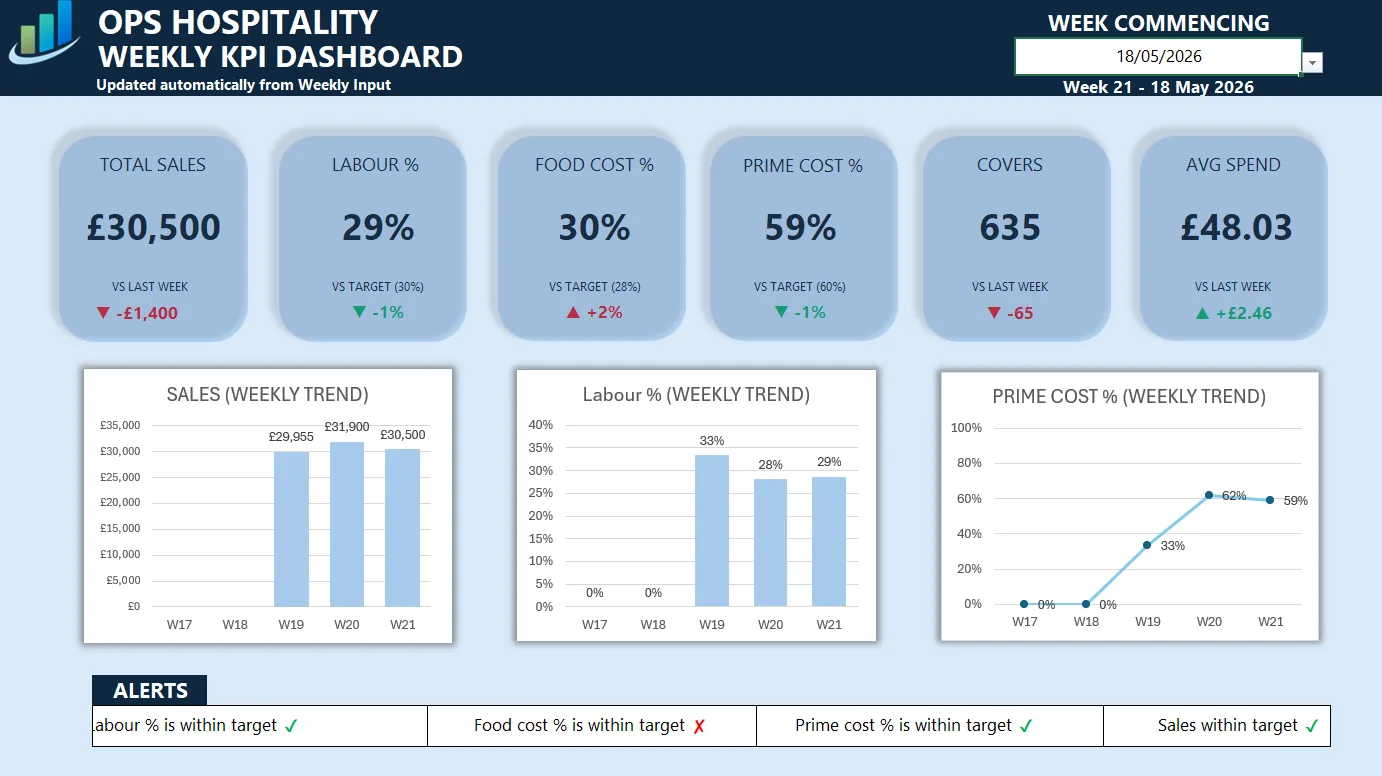
Profitability improves when managers review the same numbers every week. Use the Weekly KPI Dashboard to monitor sales, labour cost, food cost, prime cost, cash margin, net profit and performance trends in one Excel workbook.
View KPI DashboardStrong operators usually improve systems before making aggressive cuts. Sustainable profitability comes from operational discipline, not just reducing expenses blindly.
Restaurants that consistently review operational KPIs usually react faster to margin pressure than venues relying only on monthly accounting reports.
Many restaurants lose money because they focus on the wrong signals. Sales, bookings and reviews matter, but they do not tell the full profitability story.
The best profitability systems are simple and frequent. Managers need to know what changed, why it changed and what action is needed next week.
Analyse profitability, prime cost, labour percentage and operating performance.
Open tool →Track weekly sales, prime cost, labour cost, food cost, cash margin and profitability trends in Excel.
View dashboard →Estimate the sales required to cover costs and generate profit.
Open tool →Calculate menu profitability, recipe cost and pricing targets.
Open tool →Learn how ingredient control and menu pricing affect margins.
Read guide →Understand staffing efficiency and labour percentage management.
Read guide →Explore the operational metrics used by hospitality managers.
Read guide →Learn how to calculate restaurant profit margin percentage using a simple formula, example and practical operator guidance.
Read guide →Learn what a good restaurant profit margin looks like by restaurant type, service model, cost structure and cash flow position.
Read guide →Learn what cash margin means, how to calculate it and how hospitality operators use it to understand cash left after key operating costs.
Read guide →Compare cash margin and profit margin in restaurants, with simple formulas, examples and practical operator guidance.
Read guide →Restaurant profitability depends on controlling labour cost, food cost, operational waste and overheads while maintaining healthy sales volume, pricing and contribution margin.
Many restaurants operate between 3% and 10% net profit margin, although this varies significantly by concept, rent structure, labour model and operating efficiency.
High sales volume alone does not guarantee profitability. Weak labour control, poor pricing, high food cost, waste and operational inefficiency can destroy margin.
Prime cost combines labour cost and food cost into one operational profitability metric widely used in restaurant management.
Restaurants improve profitability by controlling prime cost, optimising menu pricing, reducing waste, improving scheduling efficiency and increasing average spend per guest.
Use free hospitality calculators for quick checks, then use the Weekly KPI Dashboard to track profitability, prime cost, labour cost, food cost and cash margin every week.