
Staffing efficiency
Overstaffed schedules, overtime and poor sales forecasting immediately increase prime cost pressure.
Learn how restaurant prime cost works, how to calculate prime cost percentage, what healthy targets look like and how labour cost and food cost combine to shape restaurant profitability.
Prime cost is the combined total of labour cost and food cost. In hospitality operations, these are usually the two biggest controllable expenses in the business, which is why prime cost is one of the most important restaurant profitability metrics.
Operators use prime cost because it gives a clearer view of operational performance than reviewing labour cost or food cost separately. A restaurant can have a good food cost percentage but still lose margin through poor rota planning. Another venue can control labour well but lose money through waste, over-portioning or supplier price increases. Prime cost connects both sides of the operation.
Prime Cost = Labour Cost + Food Cost
Restaurants with healthy prime cost percentages usually have stronger operational systems, better margin visibility and more control over the decisions that affect profitability every week.
Prime cost percentage shows how much of sales revenue is being used by labour and food cost combined. It is usually more useful than looking at either cost alone because it shows how much revenue is left to cover rent, utilities, insurance, marketing, maintenance, finance costs and profit.
Prime Cost Percentage = Prime Cost ÷ Total Sales × 100
For example, if a restaurant has £9,000 labour cost, £8,000 food cost and £30,000 in sales, prime cost is £17,000. Prime cost percentage is 56.7%. That means 56.7p of every £1 in sales is being used before fixed overheads are considered.
To calculate this faster across labour, food cost and sales, use the Restaurant KPI Calculator.
Prime cost connects kitchen operations, staffing efficiency and profitability into one metric. This helps operators identify whether the business model is operationally sustainable, not just whether one department looks efficient in isolation.
Overstaffed schedules, overtime and poor sales forecasting immediately increase prime cost pressure.
Waste, over-portioning, supplier inflation and inaccurate recipe costing directly affect profitability.
Prime cost helps operators understand how much revenue remains before fixed overheads and profit.
This is especially useful because labour cost and food cost often move against each other. A kitchen might reduce food cost by increasing prep time, which raises labour. A venue might reduce labour by simplifying prep, but then buy more expensive ready-made products. Prime cost shows the combined impact.
A good prime cost percentage depends on the type of restaurant, pricing, labour model, food offer and service style. However, many operators use broad ranges to understand whether the business is under margin pressure.
| Prime cost range | General interpretation | Operational meaning |
|---|---|---|
| Below 55% | Very strong | Usually reflects strong pricing, efficient staffing, good purchasing control or high average spend. |
| 55% – 65% | Healthy / manageable | Often sustainable if overheads are controlled and sales are consistent. |
| 65% – 70% | Margin pressure | Requires careful review of labour scheduling, food cost, menu mix and pricing. |
| Above 70% | High risk | Usually leaves too little room for overheads, reinvestment and profit. |
The most useful approach is to track prime cost weekly rather than monthly. By the time a monthly prime cost number looks bad, the trading period has already passed and the opportunity to correct labour, waste or pricing decisions may be gone.
Prime cost and gross profit are related, but they are not the same. Gross profit usually focuses on sales minus cost of goods sold, while prime cost combines both food cost and labour cost. For restaurants, this matters because labour is not a small background expense. It is one of the biggest drivers of profitability.
A restaurant may have strong gross profit on menu items but still struggle if the labour required to deliver those dishes is too high. A complex menu can look profitable on paper, but if it needs more prep hours, more skilled labour or longer service time, the true operational cost may be higher than expected.
Gross profit helps review menu margin. Prime cost helps review whether the operation can deliver that menu profitably.
Labour cost affects prime cost through rota planning, productivity, opening hours, management structure and service style. A venue with strong sales can still have poor prime cost if staffing is not aligned with demand.
Labour cost should be reviewed by daypart, not only by week. A weekly labour percentage might look acceptable while breakfast, lunch or late evening trading is quietly overstaffed. For deeper labour guidance, read the Restaurant Labour Cost Guide.
Food cost affects prime cost through recipes, purchasing, supplier inflation, menu pricing, waste and portion control. Even small changes can have a significant effect when repeated across high-volume menu items.
Food cost should be reviewed both at recipe level and business level. If recipe margins look healthy but total food cost is high, there may be a gap between theoretical cost and actual kitchen execution. For deeper food cost guidance, read the Restaurant Food Cost Guide.
Restaurants with healthy prime cost percentages rarely get there through one big decision. Improvement usually comes from small operational habits repeated consistently across scheduling, purchasing, prep, pricing and daily management.
The goal is not to cut labour or ingredients blindly. Poor cuts can damage service quality, staff morale and guest experience. The better approach is to remove waste from the system while protecting the parts of the operation that create revenue and repeat business.
Prime cost becomes more useful when it is tracked consistently. A monthly review is helpful for reporting, but weekly tracking gives managers enough time to adjust staffing, ordering, prep levels or pricing before the problem becomes larger.
Use total sales or relevant food sales depending on how your business tracks labour and cost categories.
Include wages, payroll-related costs and food usage, not just purchases when stock data is available.
Compare the result to previous weeks, forecast sales, menu changes and staffing decisions.
A single week can be affected by events, holidays or unusual trading. The trend matters more than one isolated number. If prime cost is moving in the wrong direction for several weeks, it is usually a sign that labour, food cost or pricing needs attention.
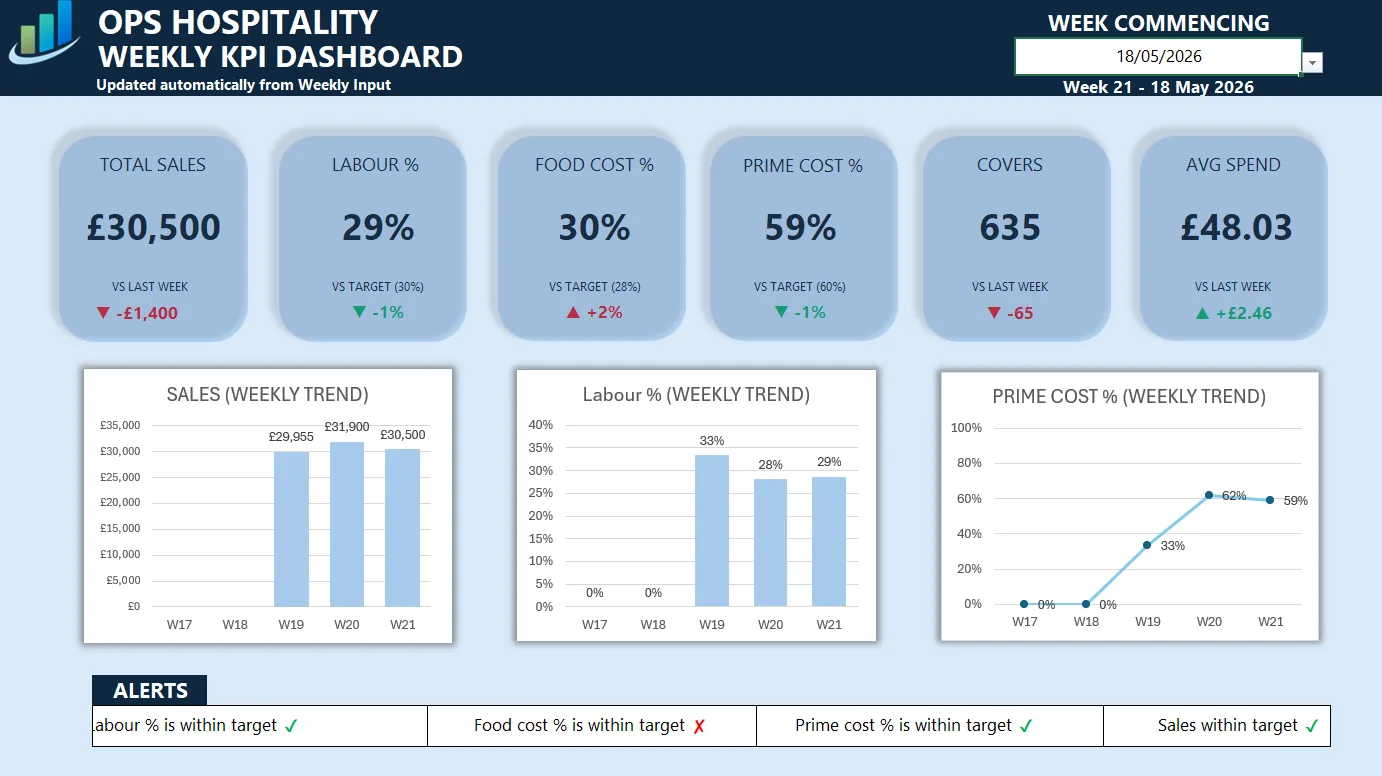
Prime cost becomes more useful when managers can compare target, actual result and trend every week. Use the Weekly KPI Dashboard to monitor labour cost, food cost, prime cost, cash margin and profitability in one structured Excel workbook.
View KPI DashboardMany operators track labour and food cost separately but do not connect them. That makes it harder to understand whether a change actually improved profitability or simply moved cost pressure from one area to another.
The best prime cost systems are simple enough for managers to use every week. They show the target, actual result, trend and reason behind the movement.
Track labour cost, food cost, prime cost and core restaurant performance metrics in one place.
Open tool →Track prime cost, food cost, labour cost, cash margin, targets and weekly profitability trends in Excel.
View dashboard →Plan weekly rota cost, payroll impact and labour percentage before staffing costs get away from you.
Open tool →Calculate recipe costs, food cost percentage, gross profit and recommended selling prices.
Open tool →Learn how staffing efficiency affects prime cost and profitability.
Read guide →Understand ingredient cost control and operational margin pressure.
Read guide →Explore how prime cost connects with break-even sales and overall performance.
Read guide →Prime cost is the combined total of labour cost and food cost. It shows how much of a restaurant’s revenue is used by its two biggest controllable operating costs.
Add labour cost and food cost together, divide by total sales, then multiply by 100. This gives the percentage of sales used by prime cost.
Many restaurants aim for prime cost between 55% and 65%, although the right target depends on concept, pricing, labour model and overhead structure.
Prime cost is important because it combines labour and food cost, giving operators a clearer view of margin pressure before fixed overheads and profit are considered.
Restaurants can reduce prime cost by improving rota planning, reducing waste, reviewing supplier prices, controlling portions, optimising menu pricing and tracking labour productivity.
Use the KPI Calculator for quick prime cost checks, or use the Weekly KPI Dashboard to track labour cost, food cost, prime cost and profitability trends every week.