
Restaurant Profit Margin Formula
Learn the restaurant profit margin formula, how to calculate profit margin percentage, and how operators use gross, operating and net profit margins to understand real restaurant profitability.
Restaurant profit margin formula: quick answer
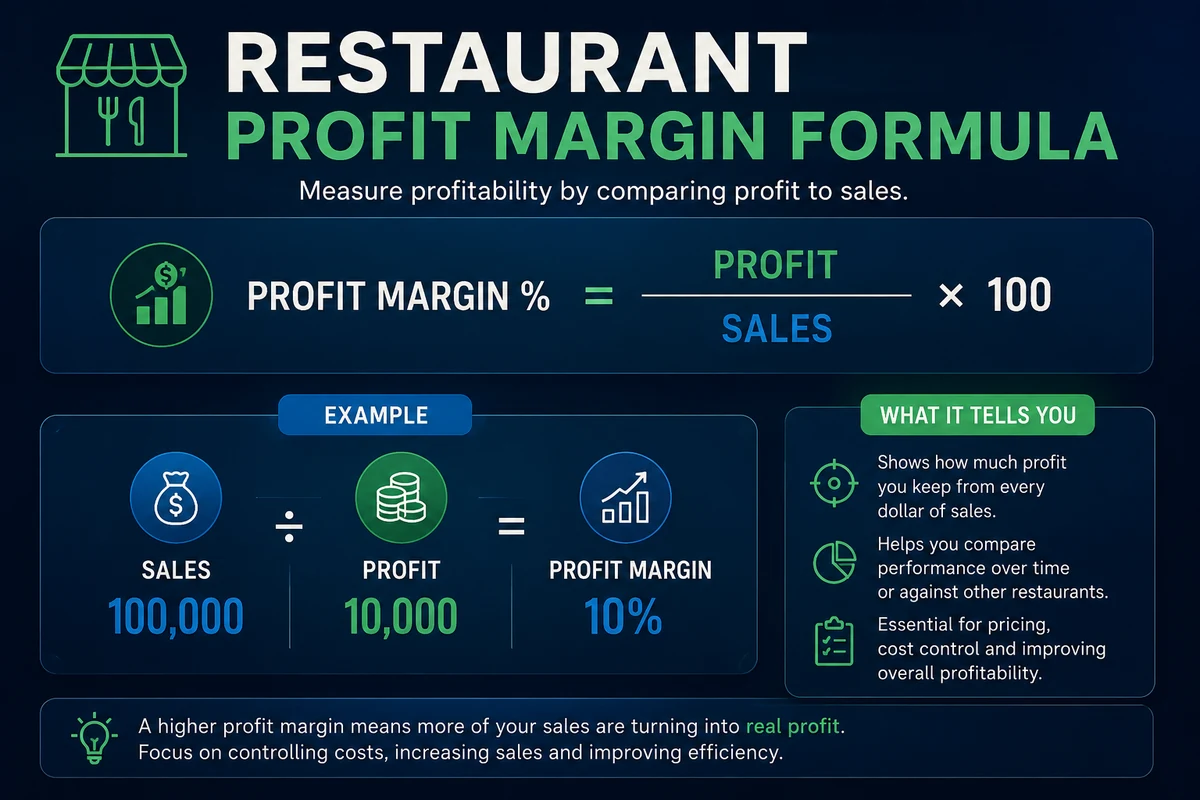
The basic restaurant profit margin formula is: Profit Margin % = Profit ÷ Sales × 100. It shows how much profit a restaurant keeps from its sales after costs are deducted.
Restaurant profit margin helps operators understand whether sales are turning into actual profit. A venue can be busy and still have weak profit margin if food cost, labour cost, rent, waste, delivery fees or other operating costs are too high.
What is restaurant profit margin?
Restaurant profit margin is the percentage of sales revenue that remains as profit after costs are deducted. It helps restaurant owners, managers, chefs, F&B managers and operators understand how efficiently the business turns revenue into profit.
Profit margin is important because sales alone do not show business health. A restaurant can increase revenue while losing margin if costs rise faster than sales. This is why operators should review profit margin alongside labour cost, food cost, prime cost, cash margin, break-even sales and cash flow.
Simple rule: sales show how much money comes into the business. Profit margin shows how much of that money the restaurant actually keeps after costs.
Shows what you keep
Profit margin helps explain how much sales revenue remains after costs.
Highlights cost pressure
Weak margin often points to labour, food cost, rent, pricing or waste issues.
Needs context
Profit margin is stronger when reviewed with KPIs, cash flow and prime cost.
Restaurant profit margin formula
The standard restaurant profit margin formula is:
In this formula, sales means total revenue for the period being reviewed. Profit depends on the type of margin you are calculating. You may use gross profit, operating profit or net profit depending on the question you want to answer.
Basic profit margin example
This means the restaurant keeps 10% of its sales as profit for the period being measured.
Gross profit margin vs operating profit margin vs net profit margin
Not all profit margin calculations measure the same thing. Before comparing results, operators should know which profit figure is being used.
| Margin type | Formula | What it helps explain |
|---|---|---|
| Gross profit margin | Gross Profit ÷ Sales × 100 | How much is left after product cost, usually food and beverage cost. |
| Operating profit margin | Operating Profit ÷ Sales × 100 | How profitable trading is after operating costs such as labour and overheads. |
| Net profit margin | Net Profit ÷ Sales × 100 | Final profitability after all costs, finance costs, tax and other deductions. |
A restaurant may have a strong gross profit margin but a weak net profit margin if labour, rent, admin, utilities, repairs, finance costs or delivery commissions are too high.
For a wider explanation of profitability drivers, read the Restaurant Profitability Guide.
Restaurant profit margin example
Imagine a restaurant has the following monthly figures:
| Item | Amount | How it affects profit margin |
|---|---|---|
| Sales | 100,000 | Starting point for the calculation |
| Food and beverage cost | 30,000 | Reduces gross profit |
| Labour cost | 32,000 | Reduces operating profit |
| Rent, utilities, admin and other overheads | 22,000 | Reduces final profit |
| Estimated final profit | 16,000 | Used for net profit margin in this example |
Net profit margin calculation
In this example, the restaurant keeps 16% of sales as final profit. If the same restaurant had higher labour cost, waste, rent or finance costs, the profit margin would fall even if sales stayed the same.
Operator insight: profit margin should not be reviewed in isolation. Always ask which cost line changed and whether the movement came from pricing, volume, labour, food cost, overheads or one-off costs.
What is a good restaurant profit margin?
There is no single good restaurant profit margin for every business. A good margin depends on the concept, rent level, labour model, menu pricing, service style, delivery mix, supplier costs, location and management systems.
A quick-service operation, café, bar, casual dining restaurant, hotel outlet and fine dining venue can all have different margin structures. This is why profit margin should be compared against the same business model, the same site over time and the targets set by the operator.
A better question is whether the restaurant profit margin is strong enough to cover risk, reinvestment, debt, owner returns, tax obligations and future cost increases.
Next step: if you want to compare your result against realistic benchmarks, read what a good restaurant profit margin looks like by restaurant type, service model and cost structure.
Why profit margin can be misleading without cash flow
Profit margin shows whether the business is profitable over a period. Cash flow shows whether money is available when payments are due. Both matter in hospitality because restaurants have frequent payroll, supplier bills, rent, tax, stock purchases and operating commitments.
A restaurant can show profit on paper but still have cash pressure if payments leave the business before enough cash is available. This is why profit margin should be reviewed alongside cash flow and cash margin.
To understand the difference, read Restaurant Cash Flow vs Profit. To compare margin metrics directly, read Cash Margin vs Profit Margin.
How profit margin connects to prime cost
Prime cost combines food cost and labour cost. These are usually two of the biggest controllable cost areas in a restaurant, so prime cost has a direct impact on profit margin.
If prime cost increases faster than sales, profit margin usually becomes weaker. This can happen when labour is over-scheduled, supplier prices rise, recipes are not updated, waste increases or menu pricing does not reflect real costs.
For a deeper explanation, read the Restaurant Prime Cost Guide. You can also use the Food Cost Calculator and Labour Cost Calculator to review two major drivers of margin.
How to improve restaurant profit margin
Improving restaurant profit margin does not always mean cutting quality. In most restaurants, better margin comes from clearer pricing, stronger cost control, better forecasting and more consistent management routines.
1. Review menu pricing and contribution margin
A popular item can still damage profit margin if its ingredient cost, prep time, waste or delivery fees are too high. Review contribution margin, not only food cost percentage.
2. Control labour before the week starts
Labour cost is easier to manage before shifts are worked. Forecast sales, plan sections and review labour hours before payroll becomes fixed.
3. Re-cost recipes when supplier prices change
Profit margin can fall quietly when supplier prices increase but recipes and menu prices are not updated.
4. Reduce waste and dead stock
Waste reduces profit twice: the business pays for the product, then loses the sales value it could have generated.
5. Watch discounts, delivery fees and commissions
Discounts and third-party costs can make sales look stronger while reducing the profit kept from each order.
6. Use break-even sales as a reality check
Break-even sales show how much revenue the restaurant needs before profit starts. If costs rise, the break-even point rises too.
Use the Break-Even Calculator to estimate the sales level needed to cover costs and protect profit margin.
Common mistakes when calculating restaurant profit margin
- Using sales without clearly defining the profit figure.
- Comparing gross profit margin with net profit margin as if they were the same.
- Ignoring labour cost when reviewing menu profitability.
- Looking at profit margin without checking cash flow timing.
- Using outdated recipe costs after supplier prices change.
- Assuming higher sales always mean better profit margin.
- Ignoring delivery commissions, discounts, waste and other hidden margin leaks.
Simple check: if sales increase but profit margin falls, the restaurant is probably growing revenue without protecting enough margin.
Restaurant profit margin FAQs
What is the restaurant profit margin formula?
The restaurant profit margin formula is Profit Margin % = Profit ÷ Sales × 100. It shows how much profit the restaurant keeps from sales.
How do you calculate restaurant profit margin?
Divide profit by sales and multiply by 100. For example, if sales are 100,000 and profit is 10,000, the profit margin is 10%.
Is gross profit margin the same as net profit margin?
No. Gross profit margin usually looks at sales after product cost, while net profit margin shows final profit after all costs and deductions.
Why is restaurant profit margin important?
Profit margin helps operators understand whether sales are turning into real profit after costs such as food, labour, rent, overheads and other expenses.
Can a restaurant have high sales but low profit margin?
Yes. High sales can still produce weak profit margin if food cost, labour cost, rent, waste, discounts or delivery fees are too high.
How can restaurants improve profit margin?
Restaurants can improve profit margin by reviewing menu pricing, controlling food cost, planning labour carefully, reducing waste, improving average spend and tracking KPIs weekly.
Track profit margin with your restaurant KPIs
Profit margin becomes more useful when it is reviewed alongside sales, labour cost, food cost, prime cost, cash margin, cash flow and break-even sales. Use the free Ops Hospitality tools to connect the numbers behind restaurant profitability.