
Smarter rotas
Forecast sales, reduce unnecessary overtime and review staffing by daypart.
Prime cost tells you whether your restaurant is operationally sustainable before overheads, rent or anything else. Here is what it means, how to calculate it and why it matters more than labour or food cost alone.
Prime cost in a restaurant is the combined total of labour cost and food cost. The basic formula is Prime Cost = Labour Cost + Food Cost. Operators also calculate prime cost percentage by dividing prime cost by total sales and multiplying by 100.
Prime cost is important because labour and food cost are usually the two largest controllable expenses in a restaurant. When prime cost is too high, the business has less room left for rent, utilities, repairs, marketing, debt, tax and profit.
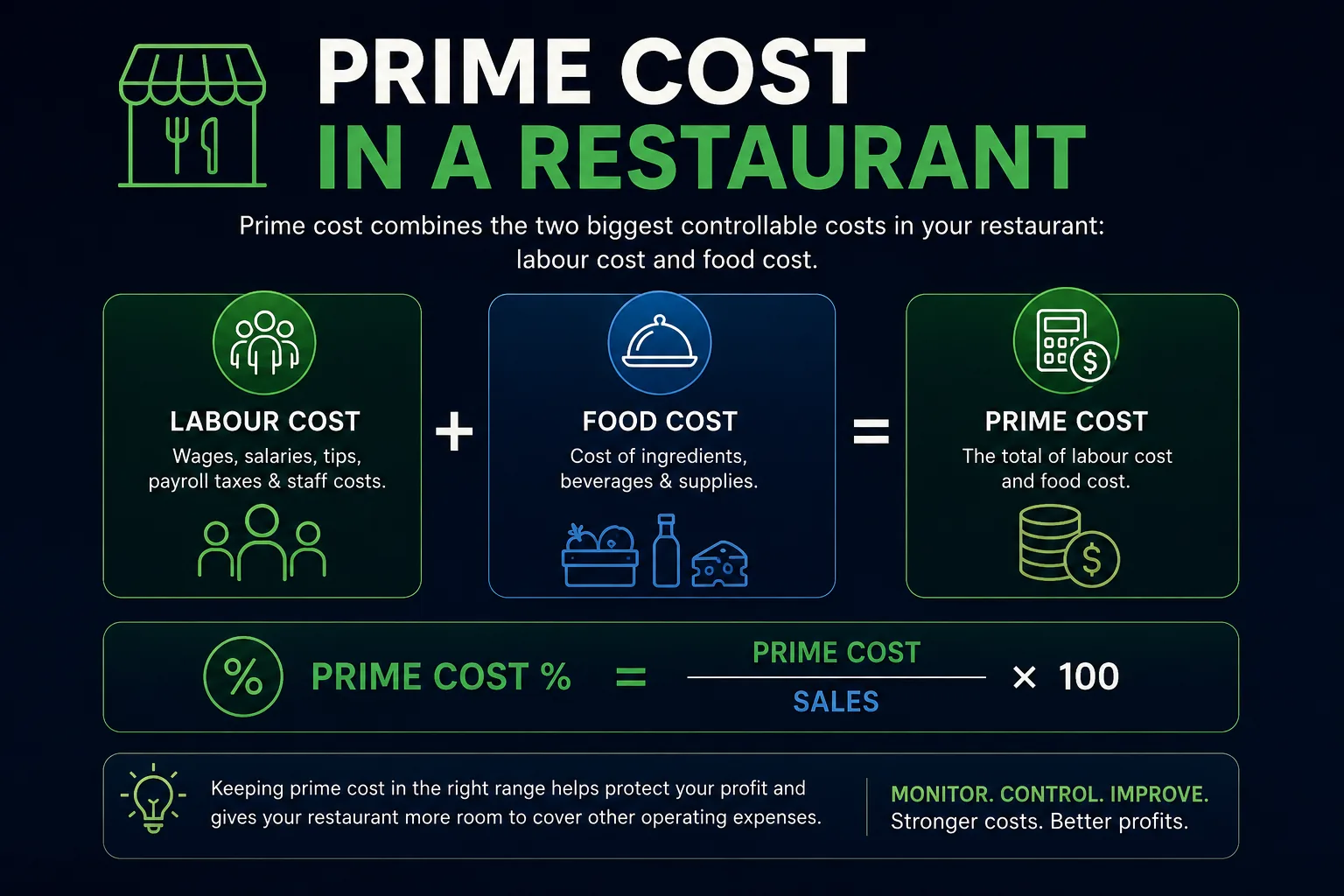
Prime cost in a restaurant is one of the most important operational profitability metrics because it combines the two largest controllable expenses: labour cost and food cost.
Most restaurants can survive temporary sales fluctuations. However, restaurants with poor control over labour and food cost often struggle to maintain healthy margins long term, even when sales look strong.
It helps hospitality operators understand whether staffing levels, menu pricing and food purchasing are financially sustainable together.
Restaurant prime cost combines total labour cost and total food cost into a single operational metric. These two costs usually have the biggest direct impact on whether the business can cover overheads and still make profit.
Prime Cost = Total Labour Cost + Total Food Cost
Many operators also calculate prime cost as a percentage of sales revenue to measure overall operational efficiency more accurately.
Prime Cost Percentage = Prime Cost ÷ Total Sales × 100
Many restaurants aim for prime cost percentages between 55% and 65%, depending on concept, pricing structure and operational model. Lower is usually stronger, but the number must be interpreted in context.
| Prime cost range | Meaning | Operational signal |
|---|---|---|
| Below 55% | Very strong | Usually indicates strong pricing, efficient staffing or excellent cost control. |
| 55% – 65% | Healthy / manageable | Often sustainable if overheads are controlled and sales are consistent. |
| 65% – 70% | Margin pressure | Needs review of labour, food cost, menu pricing and operational efficiency. |
| Above 70% | High risk | Usually leaves too little room for rent, utilities, repairs, marketing and profit. |
Restaurants sometimes focus too heavily on individual metrics without understanding the bigger operational picture.
Reducing labour cost aggressively may improve staffing percentage temporarily but damage guest experience, service speed and sales performance. Reducing food cost too aggressively can lower product quality and hurt customer satisfaction.
Prime cost forces operators to look at both sides of the equation at the same time. A venue with 28% food cost and 42% labour cost has the same prime cost problem as one running 38% food cost and 32% labour cost. The combined number shows where the margin is going.
A prime cost above 70% is a serious warning sign in most hospitality operations. Once labour and food cost consume more than 70% of revenue, covering fixed overheads like rent, utilities, insurance, maintenance and marketing becomes extremely difficult without very high sales volume or premium pricing.
Most restaurants that operate above 70% prime cost for extended periods need to raise prices, restructure the menu, reduce labour inefficiency, improve purchasing controls or rethink the operating model. The number is not always visible in daily trading reports, which is why tracking it consistently matters.
Labour cost is usually one of the largest controllable expenses in hospitality operations. It affects prime cost through rota planning, overtime, management structure, service model and sales forecasting.
If you want to understand labour metrics further, read the restaurant labour cost percentage guide or the full Restaurant Labour Cost Guide.
Food cost is the second major component of prime cost and directly affects margin stability. Supplier prices, portion control, menu engineering and waste all change the final prime cost percentage.
Learn more about restaurant food cost percentage and reducing restaurant food cost.
Prime cost works best when analysed alongside other restaurant KPIs such as sales performance, average spend, labour productivity and profitability trends.
Prime cost also affects final profitability. To understand how profit is calculated after costs, read the Restaurant Profit Margin Formula guide.
Strong hospitality operators rely on multiple operational metrics together instead of reacting to isolated numbers. For a broader KPI framework, read the Restaurant KPI Guide.
Prime cost has a direct impact on profit margin because labour and food cost reduce the amount of revenue left after operating costs. If prime cost rises faster than sales, profit margin usually becomes weaker.
Prime cost also affects cash margin because food cost and labour cost are often the first major costs deducted when operators review usable trading cash. To compare these concepts, read Cash Margin vs Profit Margin.
Improving prime cost usually requires operational discipline rather than extreme cost-cutting. The best restaurants improve prime cost through consistent weekly habits rather than one dramatic change.
Forecast sales, reduce unnecessary overtime and review staffing by daypart.
Track waste, control portions and review supplier pricing regularly.
Review menu contribution margin instead of relying only on popularity.
Calculate labour cost, food cost and prime cost to understand where your operational margin is actually going.
Prime cost in a restaurant is the combined total of labour cost and food cost. It helps operators understand the biggest controllable cost pressure before overheads and final profit.
Add total labour cost and total food cost together. To calculate prime cost percentage, divide prime cost by total sales and multiply by 100.
Prime cost measures the two largest controllable expenses in hospitality operations and helps restaurants manage profitability more effectively.
Many restaurants aim for prime cost percentages between 55% and 65%, depending on concept, pricing, service style and operational structure.
Restaurants improve prime cost through better labour scheduling, waste reduction, menu engineering, supplier review processes and operational efficiency.