
Shift productivity
Covers labour efficiency, staffing levels, sales flow, ticket times and service execution.
Learn which restaurant KPIs matter most, how to track labour cost, food cost, prime cost, sales efficiency and profitability, and how to turn weekly numbers into better operational decisions.
Restaurant KPIs are measurable operational metrics used to track performance across labour, food cost, profitability, sales, guest activity and daily operations. They help managers understand whether a venue is simply busy or actually performing well.
Strong operators rely on KPIs because they reveal problems early. Instead of reacting after margins collapse, managers use operational data to improve scheduling, pricing, staffing, purchasing and sales decisions before issues become expensive.
Restaurant KPIs help hospitality teams measure whether the business is operating efficiently, profitably and consistently.
Without KPIs, many restaurant decisions are based on gut feel. With them, managers can see where labour is being wasted, where food cost is creeping up and where revenue performance is weaker than expected.
Restaurants can track dozens of numbers, but most operators should start with the KPIs that directly affect profitability and daily decision-making. The best KPI set is simple enough to review every week but strong enough to show where operational pressure is building.
| KPI | What it measures | Why it matters |
|---|---|---|
| Labour cost percentage | Labour cost as a percentage of sales | Shows whether staffing cost is aligned with revenue. |
| Food cost percentage | Ingredient cost as a percentage of food sales | Shows whether recipes, pricing and kitchen controls are sustainable. |
| Prime cost | Labour cost plus food cost | Shows combined controllable cost pressure before overheads. |
| Sales per labour hour | Sales generated for each labour hour scheduled | Shows staffing productivity and rota efficiency. |
| Average spend per guest | Revenue generated per customer or cover | Shows pricing, upselling and menu performance. |
The biggest mistake restaurants make with KPIs is trying to track everything at once. A complicated dashboard that nobody reviews is less useful than five simple numbers that managers check consistently.
Start with labour cost percentage, food cost percentage and prime cost. These three KPIs cover most operational risk because they show whether the two biggest controllable costs are under control. Once those are stable, add sales per labour hour and average spend per guest.
Labour Cost %, Food Cost %, Prime Cost %, Sales Per Labour Hour and Average Spend Per Guest.
The key is consistency. Reviewing the same numbers at the same point each week creates a management rhythm. A weekly KPI habit is more valuable than a detailed monthly report that arrives too late to act on.
Some restaurant KPIs measure operational execution while others measure financial performance. Strong operators combine both perspectives because financial results are usually the outcome of operational habits.
Covers labour efficiency, staffing levels, sales flow, ticket times and service execution.
Covers prime cost, gross profit, profit margin, sales performance and cost control.
Covers food cost, waste, inventory movement, supplier pricing and purchasing efficiency.
For example, a poor profit margin may be caused by operational issues such as overstaffing, inconsistent portions, poor upselling or weak stock control. The financial KPI shows the result. The operational KPI helps explain why it happened.
Labour KPIs help managers understand whether staffing levels are aligned with sales. They are especially important because labour cost can increase quickly through overtime, inefficient rotas, quiet trading periods or poor productivity.
Shows how much sales revenue is spent on staffing and payroll-related costs.
Measures how much revenue each scheduled labour hour generates.
Compares scheduled hours against expected demand so managers can adjust rota coverage.
Labour KPIs are most useful when reviewed before the rota is finalised and again after the week is complete. For deeper guidance, read the Restaurant Labour Cost Guide.
Food cost KPIs show whether the kitchen is protecting margin through recipe control, supplier management, portion consistency and menu pricing. These numbers are not only for chefs or finance teams. They are operating metrics that affect daily profitability.
Shows how much food revenue is consumed by ingredients and product usage.
Shows how much cash margin a menu item contributes after ingredient cost.
Tracks lost product from spoilage, prep mistakes, overproduction and poor stock rotation.
Food cost KPIs become stronger when recipe cost is compared with actual food usage. If recipes look profitable but actual food cost is high, the issue may be waste, over-portioning, inaccurate stock counts or supplier price drift. For deeper guidance, read the Restaurant Food Cost Guide.
Sales KPIs help managers understand how well the business converts demand into revenue. Total sales matter, but they do not explain everything. A restaurant can increase sales while still losing margin if average spend, labour efficiency or menu mix is weak.
These KPIs help operators decide whether the issue is demand, pricing, upselling, staffing or menu design. They also make forecasting more accurate because managers can see which parts of the week are actually driving revenue.
Prime cost combines labour cost and food cost into one number. It is one of the most useful restaurant KPIs because it shows how much revenue is being used by the two biggest controllable costs before overheads and profit are considered.
Prime Cost = Labour Cost + Food Cost
If prime cost is too high, the business is usually under margin pressure even if sales look strong. A venue may need to review rota planning, menu pricing, supplier costs, waste, average spend or sales mix. For deeper guidance, read the Restaurant Prime Cost Guide.
Monthly reporting is often too slow in hospitality. Labour pressure, food inflation, supplier price changes, waste and sales fluctuations can damage margin quickly if operators wait weeks before reacting.
High-performing restaurants usually review KPIs weekly, and sometimes daily during busy periods. This allows managers to adjust staffing, menu pricing, purchasing, prep levels and scheduling faster.
Review sales, labour hours, covers and obvious cost pressure while managers can still react.
Review labour cost, food cost, prime cost, sales per labour hour and average spend.
Use month-end reporting to confirm trends, not to discover problems for the first time.
A KPI dashboard does not need to be complicated. The best dashboard is one managers actually use. It should show the target, actual result, change from last week and the action needed.
The most useful KPI dashboards are operational, not decorative. They help managers decide whether to adjust the rota, review supplier pricing, re-cost a dish, change prep levels or focus on upselling.
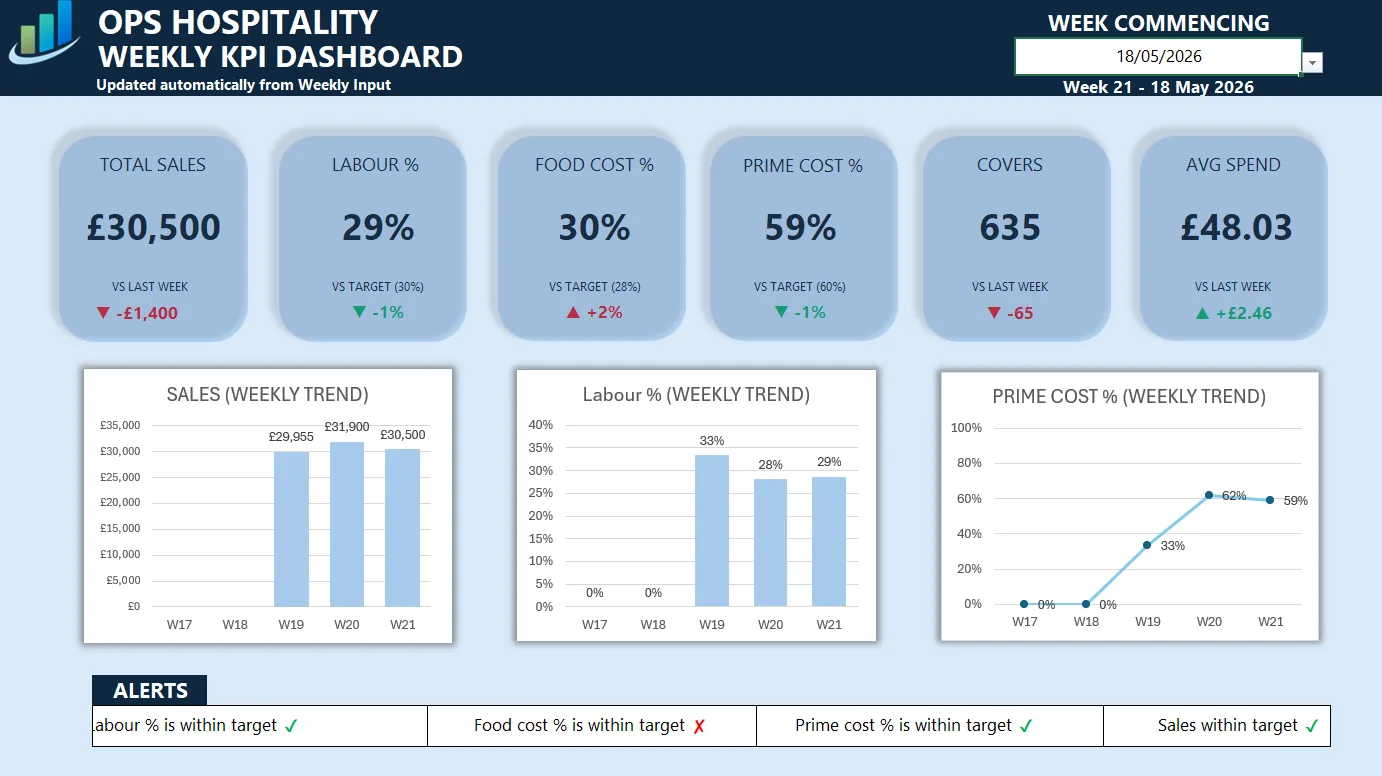
The Weekly KPI Dashboard turns sales, labour cost, food cost, prime cost, cash margin and targets into a simple Excel workflow for weekly management review.
View KPI DashboardKPI tracking fails when the numbers become too complicated, too delayed or disconnected from action. The goal is not to create reports. The goal is to improve decisions.
A good KPI system should make the next decision clearer. If a report does not help managers act, it is probably too complex or focused on the wrong numbers. To understand cash contribution more clearly, read Cash Margin in Hospitality.
Track weekly sales, labour cost, food cost, prime cost, cash margin, targets and performance trends in Excel.
View dashboard →Analyse labour cost, food cost, prime cost, average spend and profitability metrics.
Open tool →Plan rota cost, payroll impact and labour percentage before the week starts.
Open tool →Calculate recipe costs, food cost percentage, gross profit and recommended selling prices.
Open tool →Understand how KPIs connect with margin, break-even sales and operational sustainability.
Read guide →Learn what cash margin means in hospitality, how to calculate it and how operators use it to understand cash left after key operating costs.
Read guide →Compare cash margin and profit margin in restaurants, with simple formulas, examples and practical operator guidance.
Read guide →Learn how labour and food cost combine into one of the most important KPIs.
Read guide →Read the supporting article explaining the key KPI set for hospitality managers.
Read article →Restaurant KPIs are measurable metrics used to track operational performance, profitability and efficiency across labour, food cost, sales and guest activity.
Most restaurants should track labour cost percentage, food cost percentage, prime cost, sales per labour hour, average spend per guest and profitability.
KPIs help operators identify operational problems early and improve decision-making across staffing, pricing, purchasing, food cost and profitability.
Restaurants should review core KPIs weekly, with daily checks for sales, labour hours and obvious cost pressure during busy or volatile trading periods.
Prime cost is one of the most important restaurant KPIs because it combines labour cost and food cost, the two biggest controllable operating costs.
Use the free KPI Calculator for quick checks, or use the Weekly KPI Dashboard to build a consistent weekly review habit around labour cost, food cost, prime cost, cash margin and profitability.